
Document Apostille & Authentication
Since January 2024 Canada is a member of the Hague Apostille Convention. We offer a complete apostille forwarding service — we receive your document, submit it to Global Affairs Canada, and courier the apostilled certificate directly to you anywhere in the world.
Get Started →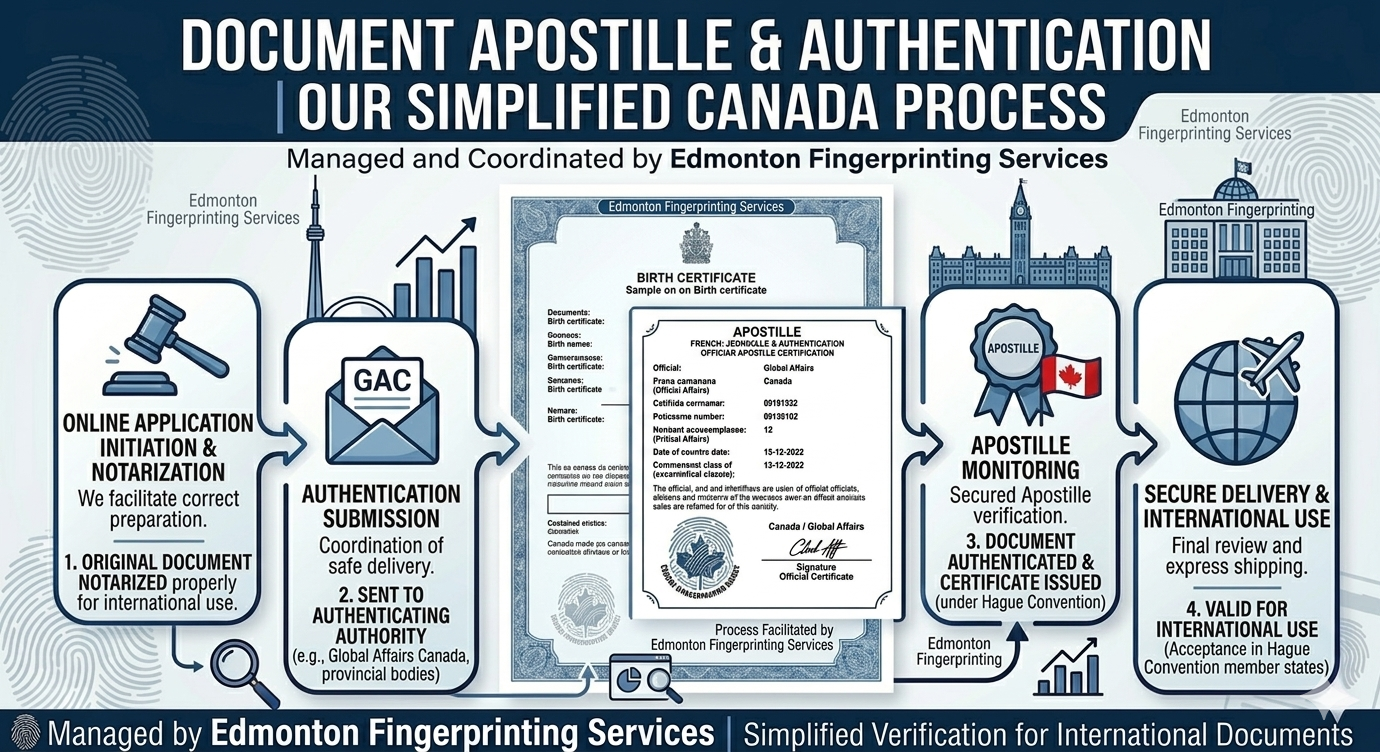
Our Apostille Service, Step by Step
Which Office Issues Your Apostille
There is no single apostille counter in Canada. Since 11 January 2024 the competent authority depends on who issued the document in the first place — and sending it to the wrong one costs weeks.
| Your document | Competent authority | Why |
|---|---|---|
| RCMP certified criminal record check | Global Affairs Canada | A federal document, wherever you live |
| Other federal documents | Global Affairs Canada | Issued by a federal department |
| Alberta birth, marriage or death certificate | Alberta Ministry of Justice | Issued by the province |
| A document notarised or commissioned in Alberta | Alberta Ministry of Justice | Affidavits, statutory declarations, powers of attorney |
| Documents from MB, NB, NL, NS, PE, NT, NU or YT | Global Affairs Canada | Those jurisdictions have no provincial authority of their own |
You do not have to work this out
Tell us what the document is and which country wants it. We identify the right authority, prepare the submission, and follow it through — including the common case where one application involves both offices, because the RCMP certificate is federal while the supporting affidavit was commissioned here in Alberta.
Who Needs an Apostille?
Immigration Applicants
An RCMP criminal record check is often required for residency or citizenship abroad.
International Employment
Employers in many countries require apostilled background checks.
Study Abroad
Universities may require apostilled transcripts or criminal clearances.
International Adoption
Foreign adoption agencies often require apostilled Canadian documents.
Marriage Abroad
Some countries require apostilled documents for foreign nationals.
If the Destination Is Not in the Convention
An apostille is only recognised by countries that belong to the Hague Apostille Convention. For everywhere else the older two-step route still applies.
Apostille
A single certificate attached by the competent authority. It is recognised on its own by every other member country — no embassy step, no consular fee, no second wait.
This now covers well over a hundred countries, including the United States, the United Kingdom, South Korea, the UAE and Australia.
Authentication, Then Legalisation
The document is first authenticated by the competent authority, and then legalised by the embassy or consulate of the destination country in Canada.
Two steps, two sets of requirements, and the consulate sets its own timelines and fees. We handle both, and we tell you at the outset which route your country falls into.
Countries Recognize the Apostille
Including the USA, UK, South Korea, UAE, Australia, Germany, France, the Philippines, Brazil, Mexico and many more.
RCMP Certificate + Apostille — One Service
Need both an RCMP criminal record check and an apostille? We handle the whole journey for you, seamlessly:
Why Choose Us
Direct Certificate Receipt
We can receive your RCMP certificate directly — no extra shipping steps for you.
End-to-End Handling
From submission to delivery, we manage every step of the process.
Worldwide Courier
Secure international delivery with full tracking, anywhere you are.
Status Updates
We monitor your submission and keep you informed throughout.
Federal Requirements
We ensure every submission meets Global Affairs Canada requirements.
One Trusted Provider
Fingerprinting and apostille under one roof — simple and reliable.
Related Services
Frequently Asked Questions
Does my RCMP criminal record check get an apostille from Alberta?
No. An RCMP certified criminal record check is a federal document, so its apostille is issued by Global Affairs Canada rather than by the province — regardless of where in Canada you live or where the fingerprints were taken.
What does Alberta’s Ministry of Justice apostille, then?
Documents issued by the Province of Alberta — birth, marriage and death certificates among them — and documents notarised or commissioned in Alberta, such as affidavits, statutory declarations and powers of attorney.
Do I still need to go to an embassy?
Only if the destination country is not a member of the Hague Apostille Convention. For member countries the apostille is the end of the process. For non-members the document is authenticated and then legalised at that country’s embassy or consulate in Canada.
When did Canada join the Apostille Convention?
The Convention entered into force for Canada on 11 January 2024. Before that date every document going abroad had to be authenticated and then legalised, whatever the destination.
Can you obtain the RCMP check and the apostille together?
Yes. That is the usual case: we take the fingerprints, submit them to the RCMP, receive the certificate, and put it straight into the apostille process, so the document does not go back and forth to you in between.
Does the apostille certify that the contents are true?
No. An apostille certifies the origin of the document — the signature, the capacity of the person who signed it, and the seal. It says nothing about the accuracy of what the document contains.
Do documents in another language need to be translated?
Frequently, yes, and the receiving authority decides whether the translation itself must also be certified or apostilled. Send us the instructions you were given and we will tell you what the sequence needs to be.
How long does it take?
It depends on the authority handling it and, for non-Convention countries, on the consulate. We give you a realistic estimate once we know the document and the destination rather than quoting a number that may not hold.
Need a Document Apostilled?
Contact us and we will guide you through the apostille process from start to finish.
Contact Us →